

Brandon Rogers Knows You're Watching
The writer and voice actor discusses Helluva Boss, Hazbin Hotel and comedic inspirations

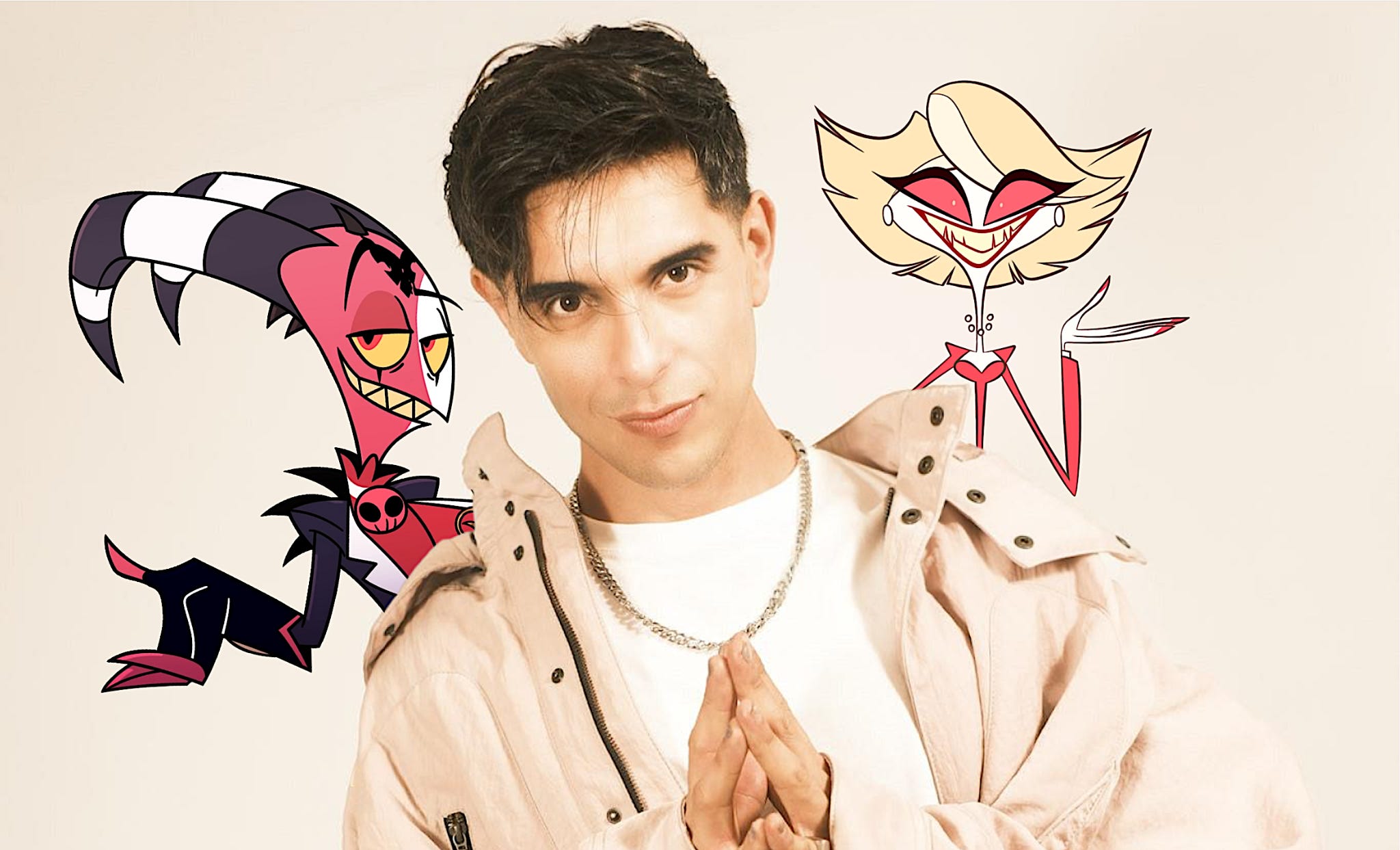
If you came of age during the 2010s glued to YouTube and Vine, there’s a good chance you’re familiar with Brandon Rogers. The actor-writer-multihyphenate rose to fame during the decade, when he became known for his outrageous sketch comedies, many of which parodied familiar archetypes like suburban WASP moms and villainous CEOs set on destroying the world. But even at the height of his viral success, he knew he wanted more.
“I tried every other type of media on the internet—except porn, probably,” he tells me over a video call. “Remember vlogging in, like, 2010? I tried that. And then I realized—don’t show people your life. Show them your art, and let your life be for you.”
It’s no surprise then, that when writer-director-animator Vivienne Medrano (known online as VivziePop) approached him about leading and co-writing a new series, his answer was a resounding yes. At the time, Medrano was a rising animation talent with a fiercely loyal YouTube following. The two would go on to collaborate on several projects, including her breakout web series Hazbin Hotel, for which Rogers voices a host of supporting characters, and its spin-off, Helluva Boss, which he co-writes with Medrano and Adam Neylan and in which he stars.
A queer, R-rated musical comedy, Hazbin Hotel is set in a neon-tinged version of Hell and centers on Lucifer’s daughter Charlie, who sets out to solve the underworld’s overpopulation problem by building a boarding house that rehabilitates sinners to earn them a passage to Heaven. Its spinoff, Helluva Boss, trades showstopping musical numbers for ultraviolence, following an imp-run assassination company that offers hitman services to the people of Hell. Rogers voices its protagonist, Blitzo (the “O” is silent), the enterprise’s flamboyant, pansexual and foul-mouthed founder, who leads a ragtag team of outcasts as they carry their assignments out on Earth, most of which involve murder.
The original premise of both shows no doubt served as a breath of fresh air to the young adults who consume them voraciously online. Rogers was equally impressed.
“I don’t remember [Vivienne] ever giving a shit about views before she was famous,” he says. “Frankly, I think she made it for her, knowing that there were enough people out there like her, that would like her show.”
Evidently, an animated series as gleefully blasphemous and genre-bending as these was always going to be an acquired taste. Both have their critics, who balk at their mix of abrasive language and juvenile humor, but regardless of where they land on the shows the breakout success of the “Hellaverse” project marks a significant milestone for independent animation and the small-scale creator economy.
Medrano had spent the 2010s financing the pilots on Patreon, and produced them alongside a team of independent artists before releasing them on her YouTube channel in 2019. Both quickly gained traction on the video-sharing platform: the pilot for Hazbin Hotel has since surpassed 100 million views, while Helluva Boss’ followed with an impressive 71 million. Their popularity earned them a groundbreaking licensing deal with Prime Video, which allows creators to retain full creative control while expanding their reach to new audiences on the platform.
Since then, Rogers has become a staple of pop-culture conventions, where he runs into Blitzo cosplayers on the regular. He also continues to run his YouTube channel, entertaining an audience of 11-million subscribers. 2025 proved especially busy for him, marked by the release of his newest short, A Night at the Park, and the second seasons of both Hazbin Hotel and Helluva Boss on Prime Video. I sat down with the creator to discuss his career, influences and creative process.
This interview has been edited for length and clarity.
First off, congratulations on such a busy year! I read an interview of yours recently, in which you talked about your approach to making your newest short film, A Night at the Park, and how that differed from some of your older videos, where you prioritized virality and spent less time writing and editing. What has changed in your artistic approach between then and now, and what’s driving this desire to strive for perfection?
Well, for a large part of before I was famous, I was trying to be famous. I was trying to get noticed, to make whatever I thought would blow up, whatever serviced the algorithm at the time. Now I’m at a point in my life where I’m no longer trying to prove myself in that way. When that voice isn’t so prevalent in your mind, it allows you to focus on what you really love. You can take your time, without trying to prove to anyone how fast you work or how unique your stuff is. All that matters is: how good is it? The internet knows I’m here, they know it’ll come out when it comes out, and there’s an audience ready for it.
Since day one, I’ve wanted to do what I’m doing now: be a storyteller. I don’t think of myself as just a writer, or any one part of a thing. I feel like a lot of my film heroes are of that same mindset. John Waters doesn’t see it as being a director, being a writer or being a producer—he sees it as being a filmmaker. He makes movies. Walt Disney wasn’t like, “I want the best theme park, or the best rides, or the best food.” He was like, “I want this to be one unified experience.” It’s one big clump.


You also cosplayed as Blitzo for A Night at the Park. I take it that fans of Helluva Boss had been wanting to see a live-action version of this character for a long time, so I wanted to ask: what has the response been like?
Surprisingly positive! I was very nervous about how people were gonna perceive him, because the standard is really high for Helluva in terms of cosplaying. We have, in my opinion, some of the best cosplayers in the world, and as the voice actor there’s this expectation that you have to be better than all of them because you’re the official source of the character. Over time, I started to meet cosplayers who’d give me pieces of their costumes—or I’d buy them. Each piece of my costume was individually made by a different cosplayer. It really is an amalgamation—like a Frankenstein of love from all over the world.
On top of voicing Blitzo, you also have multiple supporting characters in the Hellaverse. I was wondering if you had a favorite, or one that you think is under-appreciated?
I play a little French maid in the second season of Helluva Boss. She goes, [imitates French accent] “dinner is served.”
I also just love Katie Killjoy from Hazbin. Katie was my favorite character before I even got offered the role. I just loved her design, and I kind of always knew she was based off of one of my [YouTube] characters, Bryce Tankthrust. The more I watched that first pilot, I would notice her mannerisms were the same as my character’s, who also cracks her neck, and who has that smile and that outfit with the black trim. Then Viv was just straight up like, “yeah, Bryce was definitely the inspiration. Do you want to voice her?” That was cool, because it felt like one of my YouTube characters found its way onto the screen in one of the biggest independent animations out there—and playing her is easy because I just play showbiz Bryce!
As a journalist, I have to say “Katie Killjoy” is such a great name for an evil newscaster.
I think between us, we can kind of assume which journalist—or journalists—and which news station she’s inspired by. But that’s what I love about her; she’s a journalist who pokes and prods.
She’s not an honorable journalist.
No, and if anything, she’s also contributing to the degradation of Hell by reporting things that fit her interests, and that she has a lot of persuasion in. Viv was very generous with my screen time [in Season 2]. I was very happy when I saw the script, and I saw how much Katie was in there. We only ever saw her demeanor on-air before, so it’s interesting playing this character when the cameras aren’t rolling.
It makes me happy that there’s more Katie in Season 2, because she is also one of my favorites. What’s your favorite thing about the new season of Hazbin?
I think the songs definitely are a lot catchier. I loved the songs in Season 1, but I almost started Shazam-ing one of the songs during an early screening, because it was so good—and then I realized Shazam wouldn’t know these songs because they’re not out yet.
I really like “Whatever It Takes” from Season 1.
They feel like songs that you’d hear in a Disney movie, or on Broadway. And that’s largely Sam Haft. He’s actually a genius, and one of the most unsung heroes (no pun intended) of our show, because the singers get all the credit but a large part of why people love the songs is because of the melodies and Sam’s ability to transcend genres. He puts so much love and care into the music for these shows, and we’re very lucky to have him. Anyways, I’m done sucking his dick, that’s all he gets.
The maximalism of your YouTube sketches fits so well with Vivian’s style, it’s easy to see why you’re such frequent collaborators. What makes you so in-tune with each other, creatively?
It’s crazy that Viv can circumnavigate both shows at the same time. I respect the hell out of any director who has their hands on every detail of the production like Tarantino or Tim Burton, and Viv is that. She scrutinizes and analyzes every little thing that makes its way into an episode. And she’s also very collaborative. If someone has a suggestion and that’s the funnier option, it’s always “yes.” The fact that she could do that for two shows that feel very different in tone is very impressive to me.
I’m not a big animation person as an adult, but I grew up on nothing but animation, so [I have a] sensibility [to the] timing. There are less jokes in a live-action half hour than an animated half hour because it takes longer for people to physically get from point A to point B, and I try to keep my videos fast-paced. I think that’s a big reason why Viv and I—our scripts look the same. [They’re] long because they’re staccato. It’s very short lines that go by very quickly, so the page count looks daunting.
This is just my personal bias because I’m only a writer on Helluva, but I think Helluva grabs your attention quicker because it’s more slapstick, the episodes start with the stakes all crazy, and they’re more self-contained. If someone who I think wouldn’t like my work asked what I do, I would show them [the episode] “Mission Zero” from Helluva Boss, because even if they are the most conservative person in the world, they can’t deny the blood and guts it starts out with.
Is that the one with the creepy southern family? I’m a big horror nut so that’s my favorite, and I am also a little more partial to Helluva Boss for that reason.
Yeah, Helluva is just more nitty-gritty. Well, here’s the thing: I love Hazbin for exactly how it is, and I wouldn’t change it. Hazbin has a more enchanted vibe to it, the stakes are much higher and it’s more comic book-y. Helluva feels more like real-life. It’s more of a sitcom drama, the gore is visceral, what the characters go through is more relatable—something about it just feels more tangible to me. They’re not characters dealing with war, they’re dealing with interpersonal conflicts like divorce and having a baby.
That’s an interesting comparison—it does feel like a workplace sitcom in a lot of ways. Do you and Vivian draw inspiration from any particular shows?
Well first of all, Viv and I are massive fans of The Office. I’m not saying that’s where it came from, but it does speak to our larger appreciation for workplace comedy. She had just made Hazbin Hotel’s pilot and wanted a spin-off about the lower-class imps. She was looking for someone who could write a workplace comedy, and at that time, I had done web series like Blame the Hero and Theater Class, and a lot of the stuff that I had worked on dealt with situational comedy. When she brought me on board, we realized this was a violent workplace comedy. What makes the show stand out from Hazbin, is that we’ll have that juxtaposition of the brightly colored human world versus the dark, neon underworld of Hell. So that’s sort of how that came into existence.
If you look at the original, no-longer-canon pilot that we made, you see glimpses of that initial workplace comedy flavor. There’s a lot of, like, “hey, the butter in the fridge is expired,” and conference room stuff. I don’t know if just them in the office was what we were originally trying to go for, but the shorts ended up being these wacky, self-contained adventures. We realized there was drama, and extra characters that have lore, and we saw that the darkness was where the show really started to, ironically, light up.
Now we have this vessel where I oversee the funny scenes and she oversees the dramatic scenes. Her strength is writing drama, and really understating it. She’s really good at breaking hearts—in the script, not in real life. I love writing the comedic moments because my videos have been so staccato, I’m used to writing that quick, rapid-fire [dialogue] and I have a good eye for what can be tightened. That’s what I’m always telling my actors on set: “tighten it, fasten it.” Because in real life, we talk at a certain pace, but in Hazbin and Helluva, it would seem slow if the [characters] spoke normally.
The actress Jean Smart has said that “faster and funnier” is the the no. 1 note she always gets on the set of her show Hacks.
Faster and funnier, yeah! No, that’s true because I’ve never had an actor say something faster than I wanted them to. In real life, we don’t talk as fast as characters do in cartoons. So that makes sense, “faster and funnier,” because you also need to remember what parts of the sentence are punchy. It’s very easy to forget that when you’re focused only on if you’re timing it right. But anyway, comedy is a waltz.
One thing I really like about Helluva Boss—and also Hazbin, to an extent—is that it reminds me of the Cartoon Network stuff I watched as a kid.
Yeah, it doesn’t feel like adult animation in the sense that it’s not in a relatable, muted setting. I would say the maximalism is adjacent to Smiling Friends. Smiling Friends has that Cartoon Network vibe—it’s clearly for adults, but it’s poppy and loud. Helluva [also] has a Looney Tunes flavor to it. We’re not above doing, like, anvil-on-the-foot-type comedy, but at the same time, it deals with very adult things.
I think that Gen X and Millennials can ingest silly slapstick cartoons but also take them with seriousness, because animated shows were such a part of our upbringing. Twenty years ago, a lot of people would have been afraid to mix Looney Tunes-style animation with really intense, adult tones, because what’s the audience for that? We are the audience for that.
Richard Horvitz is a big reason why it feels like a Cartoon Network show, honestly. Every time I hear his voice, it’s crazy to think that, like, Billy or Zim is in Hell with us. I grew up with him as Alpha 5 from Mighty Morphin Power Rangers. At our very first con together, he came to my table and he gave me this [autographed] picture that said, “Brandon, the Power Rangers are in trouble. [Signed,] Alpha,” and then, “[Signed,] Richard.”

 Tiktok failed to load.
Enable 3rd party cookies or use another browser
That’s so sweet!
We’ve gone on so many adventures together. He is one of my favorite people, and I have gotten to know the man extremely well. He has become one of my biggest inspirations, because I’m 37. I’m sitting here, looking around me going, wow, this is all so great but who knows how long it’s gonna last, so I better enjoy it now. But then I look at Richard, and he’s still signing shit from Invader Zim and Power Rangers, and it gives me a sense of what to aspire down the road. Richard is a really good example of someone who’s very successful and very happy. We’re lucky to have someone like him on our show, who has been through the wringer and come back the other side, and is still a wonderful person. Also, I love his wife, Kristen. They’re the it-couple of every convention.
Through Richard, I’ve gotten to meet so many other wonderful voice actors. I love Christian Boyholt, the voice actor for Vox, who has rapidly grown to be one of my favorite human beings. Erica Lindbeck, who plays Luna, is honestly one of the most talented people I’ve ever met. Do not tell her I said that—I would never say that to her face. But she can do an impression of anybody, and she’s also from Smiling Friends!
Not everyone can do a deadpan voice with the same amount of personality.
She does it really well in real life, too. As much as I am Blitzo, I can say that she is also Luna. I don’t know if Viv creates these characters based on actors she has in mind, but Moxxie is Richard Horvitz, and I would say that the most fiery one of all of us is Vivian Williams, who [plays] Millie. The same goes for Hazbin. A lot of those characters and the actors who play them are very similar, both in appearance and in the way that they behave. It’s cool, and the fans love it. I also just think it makes for more believable acting. Actors resembling their characters is something that’s very common in both my work and in Viv’s.
Is that common? I read that some studios will cast characters, then design them with the voice actor in mind.
The road between character and actor should be met halfway. I feel like, as a writer, you should have in mind at least two people to play a role as you write it. At least that’s how I work. Once the actor is confirmed and I know who’s saying the words, I know how to write for them. It’s a fascinating thing, when you can tell that an actor influenced some of their characters’ choices, or their look. It’s also fun as an actor, to lean into things that other people see in you—when a character has something you already have, and you can amplify that part of you for fiction.
Blitzo is very unfiltered, which I feel can be said about most of your characters. With the far right’s constant stigmatizing of LGBTQ+ folks, there’s a narrative being pushed that people in the community must adopt respectability politics at all times, so that others don’t get the wrong idea. But amid the ongoing discourse of how to properly do jokes, you make fun of everyone and it continues to feel fresh. Could you talk a little bit about your no-holds-barred approach to comedy, whether it’s writing for Helluva Boss, or your sketches?
Yeah! Since day one, I’ve always tried to show the world that comedy unites us more than we think. This administration has been very successful at dividing us—or, I shouldn’t say they’ve been successful in dividing us, but it certainly seems to be their goal. Just like pizza or sports, comedy is one of those universal things that no matter what your political viewpoint is, we all laugh at the same things. There’s this idea on both sides of, like, “right-wing” humor and “woke” humor, but there is a middle ground where we don’t have to punch down.
I think that audiences, first of all, are very smart. That’s why I’ve survived this long: people can see I’m not punching down. I honestly think queer people are some of the funniest fucking people on the planet. I learned that when I watched The Birdcage as a child. There’s a world where someone could watch something and laugh or cry, or just be invested in some way emotionally—and then suddenly realize [they’re] watching a trans person, or a gay person, or a lesbian, you know? It’s not about being preachy.
It’s very easy to push people away, but it’s also easy to say, “you just laughed at my joke because it’s funny, and we didn’t have to look at our political differences for you to appreciate this story, or to feel for the character.” We have characters who are outwardly queer, but they never talk about it. The show is never about that. The show is about the conflicts they’re going through, and if you can see that—if you could look through this person who is not like you, and relate to what they’re going through, or laugh [with them], that’s ultimately what the goal is, for me. ■